

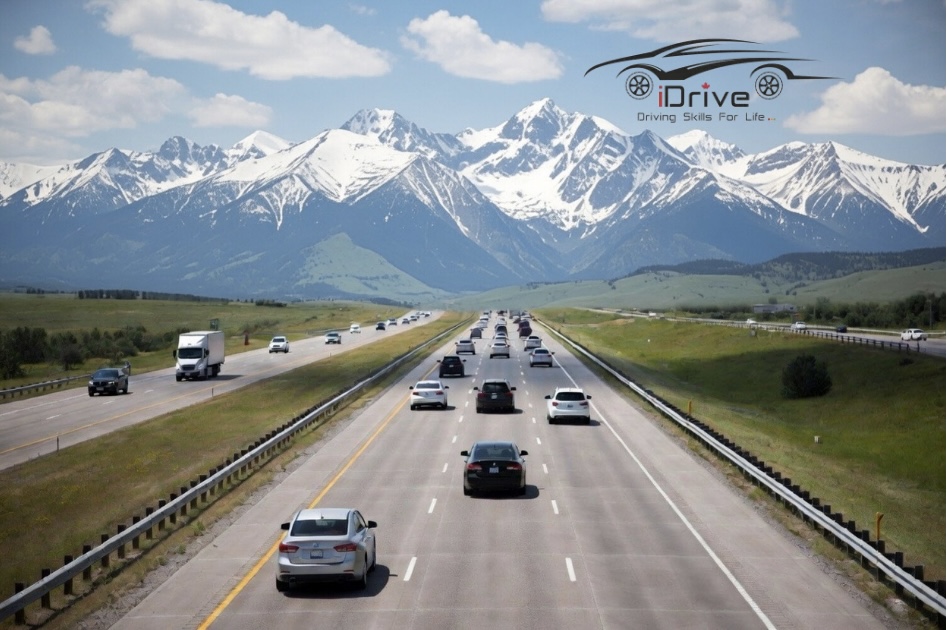
Matching Traffic Flow Without Creating New Hazards
From iDrive Alberta’s Defensive Driving Training Module
Calgary & Southern Alberta’s Trusted Driver Education Experts
In defensive driving, safety is always the highest priority. For drivers in Calgary and across Alberta, mastering how to match the reasonable flow of traffic on high-speed roads is one of the most important skills you can develop.
Driving significantly below the prevailing speed of traffic is not automatically “safer.” When done without good reason, it can place both you and the drivers behind you at greater risk. The goal of professional defensive driving training is to build the skills, judgment, and confidence to travel at a speed that matches the reasonable flow of traffic — without exceeding posted limits or driving aggressively.
When you comfortably keep pace with surrounding traffic, you reduce sudden braking, unsafe passing, and the “butterfly effect” that one slow or hesitant maneuver can trigger for dozens of other drivers.
Why Driving Too Slowly Can Create Danger on Alberta’s 100 km/h Highways
Even when it feels cautious, driving well below the flow of traffic on high-speed roads (such as Alberta’s 100 km/h highways) can force other drivers to react abruptly.
Common examples include:
• Slow merging — Entering a 100 km/h highway at 60–70 km/h often requires multiple vehicles behind you to brake hard, creating a ripple of sudden slowdowns. This is especially noticeable on busy on-ramps around Calgary.
• Lingering in the middle lane at a noticeably slower speed blocks smoother traffic flow and can encourage risky passing on both sides.
• Remaining in the rightmost lane while maintaining highway speed interferes with merging and exiting traffic, increasing conflict points near interchanges and exits.
These situations are not always illegal, but they are frequently unsafe. True defensive driving means anticipating how your actions affect others and choosing the option that minimizes overall risk.
Smart Lane Discipline on Multi-Lane Highways in Alberta
Understanding lane purpose is essential for safe, proactive driving on Alberta’s multi-lane highways and ring roads:
• Rightmost lane — Primarily for slower traffic, vehicles preparing to exit, and merging traffic. When you are traveling at or near the speed of traffic, it is often safer to move one lane left so you do not constantly interact with entering and exiting vehicles.
• Left lane — Intended primarily for passing and overtaking. Faster traffic should use it briefly to pass and then return to the right.
• Middle lane(s) — Frequently the most appropriate lane for maintaining steady, legal flow when you are comfortable with the prevailing speed. This keeps the right lane clear for merges/exits and the left lane clear for passing.
Key rule of thumb: If you are the slower vehicle, keep right. If you are comfortable matching traffic speed, use the lane that allows smooth, predictable movement for everyone.
Safety vs. Strict Legality in True Emergencies
Defensive driving recognizes that rules exist to protect life, but in genuine, unavoidable emergencies the preservation of human life takes precedence.
Classic illustration: If you are facing an imminent head-on collision and the only immediate way to avoid it is to drive onto the shoulder or into a ditch, that action — while technically illegal under normal circumstances — may be the safer choice to protect lives.
By contrast, a maneuver that is legally permitted (such as turning left or right at an intersection) can become extremely dangerous if visibility is blocked, other lanes are occupied, or traffic conditions make it impossible to complete safely.
The principle is simple: Minimize risk and protect life first. Training like ours at iDrive Alberta emphasizes building skills and anticipation so true emergencies are avoided whenever possible. When they do occur, the driver who has practiced proactive decision-making is best prepared to choose the option that causes the least harm.
Practical Takeaways for Alberta Drivers
• Build comfort and skill so you can safely match the reasonable flow of traffic on high-speed roads.
• Stay to the right when you are traveling slower than the prevailing speed.
• Use the left lane for passing only, then return right promptly.
• Avoid unnecessary lingering in the rightmost lane when maintaining highway speed.
• Practice smooth, confident merging and lane changes so you do not force other drivers to brake suddenly.
• Always ask: “What is the safest action for everyone on the road right now?”
Defensive driving is proactive, not passive. It is about reading the traffic environment, positioning yourself wisely, and moving with the flow in a way that is both legal and safe. When drivers master this balance, everyone on the road benefits from smoother, more predictable, and ultimately safer conditions.
Master These Skills with iDrive Alberta’s Defensive Driving Training
At iDrive Alberta Driver Education Inc., we teach these exact principles in our practical, real-world defensive driving programs. Our certified instructors help new drivers, teens, and experienced motorists build the judgment needed for Alberta highways and Calgary’s busy corridors.
Whether you’re working toward your licence, looking for insurance discounts through our Insurance Reduction Certificate courses, or simply want to become a more confident and proactive driver, we offer personalized training across Calgary (SE, SW, NW, NE), Airdrie, Okotoks, and Chestermere.
Ready to drive safer and more confidently on Alberta highways?
• Explore our Defensive Driving Training Course in Calgary
• View all courses and packages
• Call (587) 471-7976 or email info@idrivealberta.ca to book your lessons today.
This content is adapted from iDrive Alberta’s Defensive Driving Training Module on Highway Speed.